
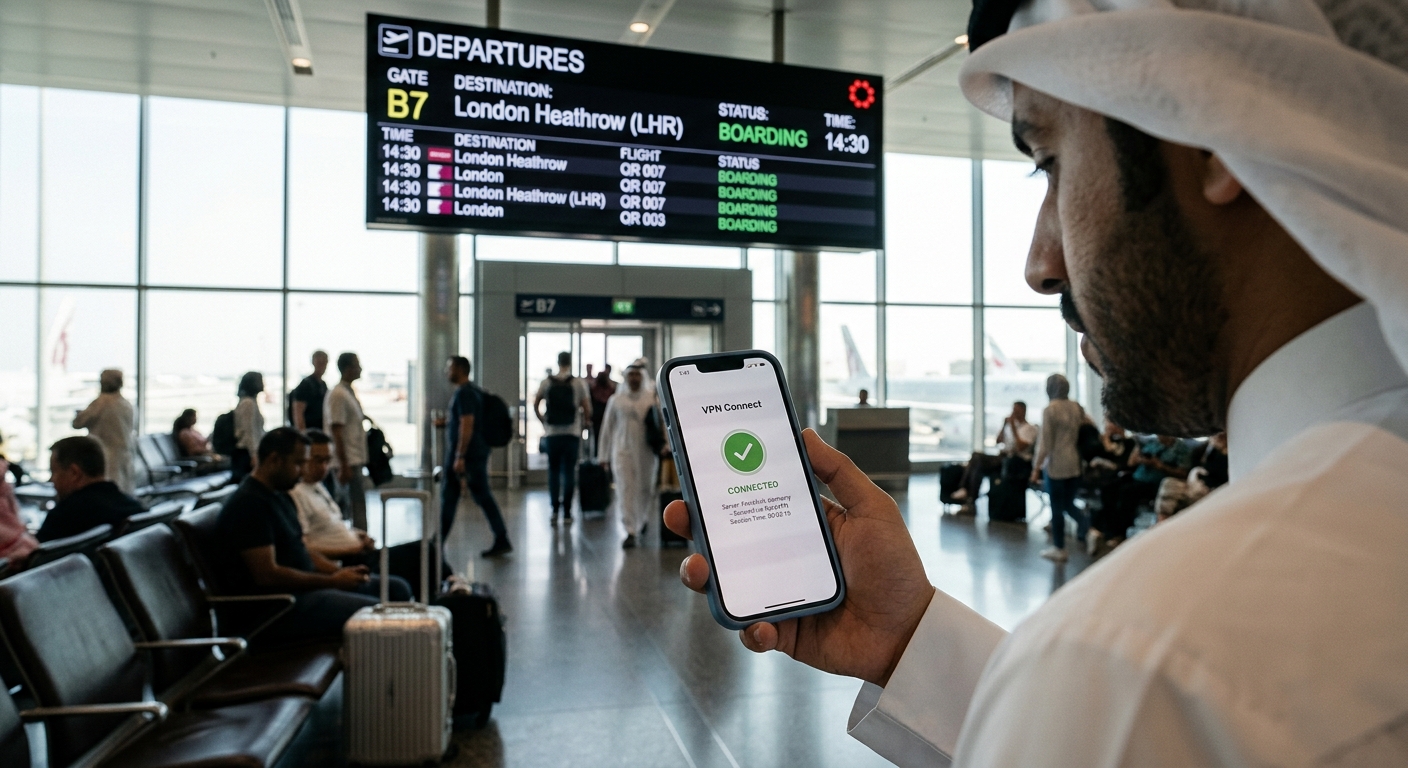
Best VPN UAE KSA Qatar Travelers: What Works Abroad
Ranked VPN guide for UAE, KSA & Qatar travelers: which providers actually work in Istanbul, London, KL & Tbilisi — plus eSIM data, Shahid streaming limits, and in-flight WiFi.

Best VPN for UAE, KSA and Qatar Travelers: What Actually Works Abroad
Key Takeaways
- NordVPN ranks #1 across all four independent reviews and is the top pick for Gulf travelers — especially those visiting Turkey or Malaysia, where obfuscated servers bypass active VPN-blocking on hotel and café networks.
- No VPN can guarantee access to Shahid live sports outside the GCC: the platform explicitly restricts it to MENA at the app level, not just by IP — download content offline before departure as the only confirmed workaround.
- WhatsApp voice and video calling works without a VPN in London, Istanbul, Tbilisi, and Kuala Lumpur — the block Gulf residents experience is a departure-market restriction, not a WhatsApp restriction.
- eSIM plans cost approximately $1.55–$2.07/day versus $5–12/day for carrier roaming; for multi-destination trips, a regional multi-country eSIM plan is typically cheaper than buying per-destination.
- Surfshark is the strongest pick for large families traveling together — its unlimited simultaneous devices policy on one subscription is a clear differentiator over NordVPN (10 devices) and ExpressVPN (8 devices).
What You Need to Know First
If you’re based in the UAE, Saudi Arabia, or Qatar, a VPN isn’t a new habit — it’s a pre-departure baseline. Freedom House’s internet freedom country scores classify both UAE and Saudi Arabia as “Not Free,” with content blocking documented across every surveyed Middle East country in 2024. You arrive at Istanbul Atatürk or Heathrow already configured.
The question this guide answers is different: which VPN actually performs when you’re traveling — on hotel WiFi in Tbilisi, on a café connection in Kuala Lumpur, at 38,000 feet on a Gulf carrier? And what can you realistically expect it to do for Shahid, OSN+, and your other Gulf subscriptions once you land?
This guide ranks five VPN providers for Gulf-originating travelers, covers eSIM connectivity for the named destinations, and addresses in-flight WiFi on GCC carriers. It is honest about one gap: no independent source we found has tested VPN unblocking of Shahid, OSN+, or beIN Sports specifically. That gap shapes several recommendations below — read the Shahid section before you buy anything.
Who this guide is for: UAE, KSA, and Qatar passport holders — solo travelers, couples, and families — departing to Istanbul, London, KL, Tbilisi, Baku, or the Maldives, with active Gulf streaming subscriptions and at least one family member who needs WhatsApp calling open.
The Gulf Streaming Reality Before You Buy a VPN
This is the single most important section in this guide. Before you look at rankings, understand what a VPN can and cannot do for your Gulf subscriptions.
Most Gulf travelers now subscribe to bundled products, not individual streaming services. Two dominant bundles exist as of late 2025:
- Shahid + Disney+ + OSN+ at approximately $25/month, covering Shahid Arabic originals, the Disney+ catalog, and OSN+’s HBO content — documented by Arab News in December 2025
- Shahid + Netflix + MBC via MBC NOW, launched in Saudi Arabia in February 2025, offering approximately 21% savings over separate subscriptions — documented here
When you ask “will my VPN work for Shahid abroad,” the bundle structure matters — but here’s the harder truth: the Shahid App Store listing explicitly states that live sports content (“Live Sports in HD”) is available in MENA only. That is a platform-level restriction, not a simple IP-level geo-block.
IP-level vs. platform-level: why this distinction matters
A VPN changes your apparent IP address, routing your traffic through a server in — say — Dubai, so a website sees a Dubai IP instead of your Istanbul hotel IP. That works well for international services like Netflix, BBC iPlayer, and YouTube, which enforce geo-restrictions purely by IP address.
Shahid’s live sports restriction appears to go deeper. The platform may also check device locale, payment account region, or app store origin. A VPN that successfully presents a MENA IP may still fail the sports content gate. No independent source we found has tested this. The question — “can I watch Al Hilal in my London hotel room on Shahid with a VPN?” — has no confirmed answer in either direction.
What the MBC Shahid Wikipedia entry does suggest is that the VOD (on-demand) tier has broader worldwide availability — so your Arabic series may load fine abroad while your live sports may not, regardless of which VPN you’re running.
The practical advice: Download your Shahid content for offline viewing before you depart. That is the highest-confidence solution for the sports and live content gap. No VPN vendor can promise better than that right now.
For OSN+ and beIN Sports abroad: we could not find authoritative confirmation of their geo-restriction posture for GCC subscribers traveling outside the region. Verify directly with each service before your trip.
The Rankings: Best VPN for UAE, KSA and Qatar Travelers
These five providers are ranked for Gulf-originating travelers on four axes: independently-tested performance, server coverage relevant to Gulf-popular destinations, obfuscation capability for networks that actively block VPN traffic, and privacy credentials. Streaming performance reflects international services (Netflix, BBC iPlayer, Disney+) — not Gulf-specific services, for the reasons above.
Rankings are based on Security.org’s tested travel VPN picks, CNET’s travel VPN selection guide, Vanabond Tales VPN testing across 90+ countries, and BleepingComputer’s travel VPN guide 2025 — four independent editorial reviews with distinct testing methodologies.
1. NordVPN
NordVPN appears at the top of all four independent reviews. The reasons are consistent: large server network (111 countries), low average speed loss under testing, obfuscated servers that work on networks actively blocking VPN traffic, a verified no-log policy with third-party audit, and a kill switch that prevents data exposure if the connection drops.
For Gulf travelers, the obfuscation capability is load-bearing. If you’re traveling to Turkey (classified as Not Free by Freedom House) or Malaysia (Partly Free), standard VPN protocols can be detected and blocked. NordVPN’s obfuscated servers disguise VPN traffic as regular HTTPS — which matters on hotel and café networks in destinations with active filtering.
The limitation: Like all providers ranked here, NordVPN has not been independently tested against Shahid live sports or OSN+ geo-restrictions specifically. For international streaming, it is the most consistently tested option across all four reviews.
| What it does well | Watch out for |
|---|---|
| Top-ranked across all four independent reviews | No independent Gulf-streaming test data |
| Obfuscated servers for filtered networks | Slightly higher price than Surfshark |
| Verified no-log policy (audited) | |
| Kill switch, DNS leak protection | |
| Up to 10 simultaneous devices |
- Best for: Families traveling together who need multi-device coverage; travelers going to Turkey or Malaysia where VPN-blocking is documented
- Approximate price: ~$3.39–$4.99/month on 2-year plans (verify current pricing at nordvpn.com — prices change)
- Independent reviews: Security.org · CNET · BleepingComputer · Vanabond Tales
2. ExpressVPN
ExpressVPN is the consistent #2 or joint-#1 across the same four reviews. Its distinguishing feature: a Lightway protocol designed to maintain stable connections on high-packet-loss or congested networks — relevant for hotel WiFi in Tbilisi, Baku, and parts of KL.
CNET’s travel VPN selection guide specifically cites ExpressVPN’s per-app split tunneling as useful for travelers who want to route only certain apps through the VPN — useful if local banking apps block VPN IPs while you keep streaming through the tunnel.
The tradeoff is price: ExpressVPN is the most expensive option in this ranking. For a single trip, the monthly rate is high. For frequent Gulf travelers, the annual cost typically justifies against the alternatives.
| What it does well | Watch out for |
|---|---|
| Lightway protocol for unstable connections | Most expensive option in this ranking |
| Per-app split tunneling | No independent Gulf-streaming test data |
| Consistent #1–2 across all four independent reviews | |
| Trusted Servers technology (RAM-only, no data written to disk) | |
| Available in 105 countries |
- Best for: Frequent travelers, remote workers on variable connections, travelers who need split tunneling to use local banking apps alongside streaming
- Approximate price: ~$6.67–$8.32/month on annual plans (verify current pricing at expressvpn.com)
- Independent reviews: Security.org · CNET · Vanabond Tales · BleepingComputer
3. Surfshark
Surfshark ranks third — not because of inferior testing results, which place it in the top tier across all four reviews — but because its primary differentiator (unlimited simultaneous devices) is already approximated by NordVPN’s 10-device plan, and its most prominent speed claim comes from its own marketing page.
On that speed claim: Surfshark’s own website cites a 1,615 Mbps speed figure attributed to Techradar. That is Surfshark’s own marketing page, not an independent benchmark. The independent reviews do not rank Surfshark above NordVPN or ExpressVPN on consistent real-world speed. Use the independent review data, not Surfshark’s self-published figures, as your benchmark.
Where Surfshark genuinely stands out for Gulf families: unlimited device connections on a single subscription. If you’re traveling with a spouse, two teenagers, and elderly parents sharing one VPN account, that device policy is meaningfully different from competitors.
BleepingComputer’s travel VPN guide 2025 also highlights Surfshark’s NoBorders mode — an obfuscation feature for restrictive networks — as a practical option for the Gulf-popular destination set.
| What it does well | Watch out for |
|---|---|
| Unlimited simultaneous devices | Speed claims on vendor page are not independently confirmed |
| NoBorders mode for restrictive networks | No independent Gulf-streaming test data |
| Lowest per-month price among the top three | |
| Reviewed by all four independent sources | |
| CleanWeb (ad/tracker blocking) useful on public WiFi |
- Best for: Large families or travel groups sharing a single subscription; budget-conscious travelers who need the top-tier feature set
- Approximate price: ~$2.19–$2.49/month on 2-year plans (verify current pricing at surfshark.com)
- Independent reviews: Security.org · CNET · Vanabond Tales · BleepingComputer
4. CyberGhost
CyberGhost enters the ranking through BleepingComputer’s travel VPN guide 2025, which gives it specific credit for dedicated streaming servers (pre-configured for specific platforms) and an extensive server network (100 countries, 10,000+ servers).
It ranks fourth rather than higher because it appears in three of the four independent reviews — not all four — and CNET’s travel VPN selection guide notes a slower no-log audit cadence compared to NordVPN and ExpressVPN. For Gulf travelers whose primary concern is privacy on hotel WiFi, audit cadence is a real differentiator, not a formality.
CyberGhost is a reasonable choice if your destination is London or another Western European city, your primary goal is unblocking international streaming libraries, and your privacy threat model is low. If you’re going to Turkey or a destination with active VPN filtering, go higher in this list.
| What it does well | Watch out for |
|---|---|
| Dedicated streaming servers for specific platforms | Less consistent no-log audit cadence |
| 10,000+ servers in 100 countries | Not in all four independent reviews |
| Strong cybersecurity-press track record | Obfuscation less proven in restrictive networks |
| 7 simultaneous devices | No independent Gulf-streaming test data |
- Best for: London, Western European, or Southeast Asian trips where international streaming access is the primary use case and privacy threat is low
- Approximate price: ~$2.03–$2.19/month on 2-year plans (verify current pricing at cyberghost.com)
- Independent reviews: BleepingComputer · Security.org · Vanabond Tales
5. ProtonVPN
ProtonVPN ranks fifth for travel use — not because of weak privacy credentials, which are the strongest of any provider on this list — but because its server network is smaller than the top four for Gulf-popular destinations, and its free tier is inadequate for streaming or sustained travel use.
Security.org’s tested travel VPN picks include ProtonVPN with specific praise for its open-source client and independent audit trail. For a Gulf traveler whose primary concern is genuine data privacy on public WiFi — rather than streaming access — ProtonVPN deserves serious consideration. For the traveler who wants to watch international content reliably across Istanbul, KL, and Tbilisi, the smaller server network puts it behind the top three.
Vanabond Tales VPN testing across 90+ countries also flags Mullvad as a niche pick for travelers with strong privacy requirements (no email required for signup, no account data collected). Mullvad is outside this ranking’s top five — it lacks the server breadth and streaming optimization of the leaders — but if privacy is your priority, it is worth researching directly.
| What it does well | Watch out for |
|---|---|
| Strongest privacy architecture on the list | Smaller server network than top three |
| Open-source client, independently audited | Streaming performance lags leaders |
| Swiss jurisdiction (strong legal privacy protections) | Free tier not suitable for sustained travel use |
| Stealth protocol for censored networks | No independent Gulf-streaming test data |
- Best for: Travelers with elevated privacy requirements — journalists, business travelers, anyone concerned about data on public WiFi — who prioritize verifiable no-log architecture over streaming optimization
- Approximate price: ~$4.99–$9.99/month (verify current pricing at protonvpn.com)
- Independent reviews: Security.org
Comparison Table
| Rank | Provider | Best for | Approx. monthly (2-year plan) | Independent reviews |
|---|---|---|---|---|
| 1 | NordVPN | Families, Turkey/Malaysia travelers, obfuscation needed | ~$3.39–$4.99 | All four |
| 2 | ExpressVPN | Frequent travelers, split tunneling, unstable connections | ~$6.67–$8.32 | All four |
| 3 | Surfshark | Large families/groups (unlimited devices), budget-conscious | ~$2.19–$2.49 | All four |
| 4 | CyberGhost | London/Western Europe, streaming-focused, low-risk destinations | ~$2.03–$2.19 | Three of four |
| 5 | ProtonVPN | Privacy-first travelers, journalists, business travelers | ~$4.99–$9.99 | One of four (travel-specific) |
All prices approximate and subject to change. Verify current plans directly with each provider.
WhatsApp Calling and VoIP Abroad: What You Don’t Need a VPN For
In most Gulf-popular destinations, you do not need a VPN to make WhatsApp voice or video calls. The GEtours guide to using WhatsApp abroad treats WhatsApp calling as available at standard international destinations without flagging VoIP blocking as a concern. Freedom House country data confirms:
- London (UK): No VoIP restrictions
- Istanbul (Turkey): Classified Not Free overall, but WhatsApp calling is not the primary documented restriction
- Kuala Lumpur (Malaysia): Partly Free — some restrictions exist, but general WhatsApp functionality is available
- Tbilisi (Georgia): Free classification — no VoIP restrictions
What this guide cannot confirm: VoIP availability in the Maldives, Baku, and specific rural zones in any destination. If your trip includes those destinations, verify current conditions before departure.
The key point: WhatsApp calling is blocked at home in the UAE and KSA — not because WhatsApp blocks it, but because the local telecom environment does. When you’re physically abroad in any of the destinations above, that restriction does not follow you. A VPN is not required for WhatsApp calling in London or Tbilisi.
Getting Data Abroad: eSIM vs. Roaming
Your VPN needs an internet connection to function. For Gulf travelers, that decision has become straightforward: eSIM is substantially cheaper than carrier roaming, and most current Gulf-market phones (iPhone XS and later, most flagship Android devices) support eSIM.
Pricing below is from eSIM providers — all vendor sources, so treat these as floor indicators, not independent market data:
| Option | Typical daily cost | Notes |
|---|---|---|
| eSIM (destination-specific) | From ~$1.55–$2.07/day | Airalo · Simify |
| eSIM (regional, multi-country) | Varies by plan | Roamvy regional plans for GCC travelers cover 19 countries |
| Carrier roaming | $5–12/day | Per Airalo’s comparison data |
| Portable WiFi device | $8–15/day | Highest cost, least convenient for multi-destination trips |
For a trip covering two or three destinations — Istanbul then Tbilisi, or London then KL — a regional multi-country eSIM plan is typically more economical than buying separate single-country plans. Roamvy’s GCC eSIM guide and Airalo’s comparison both offer regional options; as vendor sources, compare them against each other and check current availability.
One practical note: set up your eSIM and test your VPN connection before you leave home. Troubleshooting a configuration issue in a Turkish airport is harder than doing it in your living room in Riyadh.
In-Flight WiFi on Gulf Carriers
If you’re flying a Gulf carrier to any of the named destinations, you now have meaningful in-flight connectivity — which changes the practical sequence.
According to Connecting Travel’s February 2026 report on GCC airline WiFi:
- Qatar Airways became the first GCC airline to offer Starlink WiFi, on the Doha–London route (2024)
- Emirates, Saudia, and Flydubai are rolling out free WiFi in 2026
- Speeds up to 800 Mbps are cited for Starlink-equipped aircraft
This means you can install and test your VPN app during the flight rather than waiting for hotel WiFi at your destination. You also have a real internet connection for downloading Shahid content before you land, if that’s part of your plan.
One gap this guide cannot close: whether GCC airline in-flight WiFi networks permit VPN traffic. Some commercial in-flight WiFi systems restrict VPN protocols. No official airline policy statement was available for Qatar Airways, Emirates, or Saudia on this question. If VPN use on the aircraft matters to your trip, contact the airline directly before you fly.
How We Ranked
Rankings are based on appearance and performance across four independent editorial reviews: Security.org (300-speed-test methodology), CNET (editorial testing with explicit selection criteria), Vanabond Tales (practitioner field-testing across 90+ countries), and BleepingComputer (cybersecurity specialist press).
CNET’s explicit selection criteria — server network in 60+ countries, speed loss of ≤25% under testing, kill switch, DNS leak protection, verified no-log policy with third-party audit — served as the evaluation backbone. Providers appearing across all four reviews with consistent positive findings rank higher than those in fewer. Where providers share a tier (NordVPN, ExpressVPN, Surfshark are all multi-source top picks), separation reflects secondary differentiators relevant to Gulf travelers: obfuscation capability for Turkey and Malaysia, device limits for family travel, and price-to-feature ratio.
What this ranking does not reflect: streaming performance for Shahid, OSN+, or beIN Sports. No independent test of this exists. Treat any VPN vendor claiming guaranteed Shahid unblocking with caution until independent testing confirms it.
The Freedom House internet freedom country scores and Freedom House FOTN 2024: Middle East internet restrictions provided the departure-context baseline — the Gulf travel VPN picture cannot be understood without understanding why Gulf travelers are already VPN-experienced before they board.
Legal Posture: VPN Use Abroad
VPN use is legal in all destination countries covered in this guide: UK, Turkey, Malaysia, Georgia, and the Maldives.
For your home-country regulations — UAE, Saudi Arabia, Qatar — the question of how domestic VPN rules apply to citizens physically abroad cannot be answered definitively here. No authoritative legal source addressing this specific question was available in our research. The Against the Compass VPN guide for Saudi Arabia and Khaleej Times GCC VPN penetration data both address the domestic regulatory context, but neither confirms the extraterritorial picture for travelers.
For guidance on your home-country regulations: contact UAE TRA, Saudi CITC, or Qatar QNBS directly. Do not rely on travel guides — including this one — for legal advice on this question.
FAQ
Do I need to install my VPN before leaving the UAE, KSA, or Qatar?
Yes. Install and test your VPN before departure, not after landing. App stores and VPN provider websites may be restricted or slower to access depending on your destination’s network environment. Testing at home ensures your chosen server locations are working and your kill switch is configured correctly.
Will my VPN let me watch Shahid sports abroad?
We cannot confirm this. The official Shahid App Store listing states live sports is available in MENA only. This may be a platform-level restriction that a VPN cannot fully bypass — no independent source has tested it. Download live matches and sports content for offline viewing before you depart. Shahid VOD (on-demand) content may be available more broadly, but this guide cannot confirm the mechanism.
Is WhatsApp calling blocked in Istanbul, London, or KL?
No — WhatsApp voice and video calling is available at all three destinations without a VPN. The restriction you experience at home is a departure-market limitation, not a WhatsApp restriction. When you are physically abroad in those destinations, WhatsApp calling works normally.
What is the cheapest way to get data abroad as a Gulf traveler?
eSIM plans from major providers typically run from approximately $1.55–$2.07/day, compared to $5–12/day for carrier roaming, per pricing data from Airalo and Simify. These are vendor sources — confirm current pricing directly. For multi-destination trips, a regional multi-country plan is typically more economical than separate destination-specific eSIMs.
Can I use a VPN on Emirates or Qatar Airways WiFi?
We could not confirm this. No official airline policy statement was available for either carrier on VPN use. Contact the airline directly before your flight if this is important to your trip.
Which VPN is best for a family of five traveling together?
Surfshark, for the unlimited simultaneous devices policy. One subscription covers every device in the family at no additional cost. NordVPN (10 devices) and ExpressVPN (8 devices) may be sufficient for smaller families; for larger groups, Surfshark’s unlimited-device policy is the clearest differentiator.
Are GCC VPN penetration rates available?
The most recent figure in our research is from 2021: Qatar at 44.47%, UAE at 39.91% per Khaleej Times data from August 2021. These are historical figures only — do not treat them as current market data.
The Summary
Top pick: NordVPN for most Gulf travelers — the best-supported, independently tested option across the widest range of travel scenarios, with obfuscation that matters if you’re going to Turkey or Malaysia.
Runner-up: ExpressVPN for frequent travelers and anyone working remotely on variable connections.
Budget pick for families: Surfshark, specifically for unlimited simultaneous devices.
The watch-out: No VPN can guarantee access to Shahid live sports or beIN Sports outside the GCC. Download content offline before you depart. That is the most reliable solution this guide’s research can support — and any VPN provider that promises otherwise should show you an independent test result before you take that claim at face value.

-

 UAE5 months ago
Best Desert Safari Dubai: Top Companies Ranked for 2026
-

 QA5 months ago
Doha for Gulf Travelers: Halal Hotels, Districts & Qatar Airways Stopover
-

 KSA5 months ago
Best Makkah Hotels Near Haram: Walking Distances & Family Prices
-

 UAE4 months ago
Where to Watch the World Cup in Dubai 2026: 12 Best Venues
-

 UAE5 months ago
Best Pizza and Pasta in Dubai: 8 Italian Restaurants Worth the Drive
-

 UAE5 months ago
Best Coffee Shops in Dubai by Neighbourhood
-

 UAE5 months ago
Cheap Rental Cars in Dubai Airport vs City: Full Cost Guide
-

 UAE5 months ago
Women Padel Dubai: Sessions, Courts & Privacy Options