QA
Qatar Beyond the Resort: A Gulf Traveler’s Guide to Doha
What happens when you leave the resort? Katara, halal dining, DOH prayer infrastructure, and the real Doha-vs-Dubai price comparison for Gulf families.

Key Takeaways
- GCC passport holders enter Qatar visa-free; expats on non-GCC passports should default to the Hayya Platform eVisa — the approved profession list for Visa on Arrival is not publicly available in any English-language source.
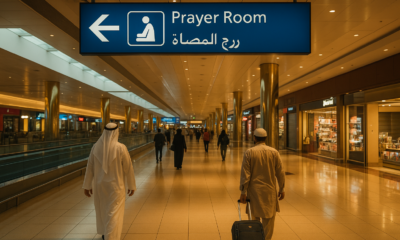
- DOH has 16 musallas across all five concourses plus a 500-person external mosque; the adhan is broadcast terminal-wide, so no prayer-time app is needed during a layover.
- Doha’s 5-star hotels are frequently cheaper than Dubai equivalents, but Dubai’s mid-range and budget tiers are more competitive — Tripbase puts Doha’s daily baseline at €60 vs. Dubai’s €45.
- Not all Doha restaurants are alcohol-free: hotel restaurants at The Pearl including Babel and Chicago Rare hold alcohol licenses — check venue by venue, not by destination.
- Ramadan is a travel positive for Gulf Muslim families in Doha, with documented programming at Katara Cultural Village, Souq Waqif night markets, major hotels, and Imam Muhammad Ibn Abdul Wahhab Mosque for Taraweeh.
What You Need to Know First
This guide is for Gulf travelers — GCC passport holders and GCC-resident expats — planning a Doha short break of two to four nights. It covers the question most Qatar travel content skips: what happens when you leave the resort. Katara Cultural Village, Doha’s halal dining landscape, DOH’s prayer infrastructure, and the honest Doha-vs-Dubai price comparison are all here. Qatar Airways route optimization and Umrah-adjacent routing are outside this article’s evidentiary scope and flagged where relevant.
Visa and Entry: Two Different Calculations
Your entry to Qatar depends on which passport you carry, not which country you live in.
If You Hold a GCC Passport
Entry is visa-free. No application, no fee, no pre-registration. This applies to Saudi, UAE, Kuwaiti, Bahraini, Omani, and Qatari nationals. Confirm your passport tier against the Visit Qatar official visa check tool before travel — not because the rule is in dispute, but because Qatar’s visa policy changed repeatedly between 2022 and 2026, and secondary sources may lag.
If You Hold Another Passport and Live in a GCC Country
This calculation is more complex than most Qatar travel content acknowledges.
Two pathways exist:
- Visa on Arrival at DOH — QAR 100 fee, 30-day stay, 90-day extension possible. Subject to two conditions that can cause rejection at the immigration desk: your profession must appear on Qatar’s approved profession list, and you must carry proof of health insurance and a confirmed hotel booking. The approved profession list does not appear in any publicly available aggregator source. Its contents are the single most important unresolved visa question for GCC-resident expat travelers. Until this list is obtained through original reporting, treat Visa on Arrival as the higher-risk pathway if your occupation is in a service, domestic, or construction category.
- Hayya Platform eVisa (pre-application) — Apply before travel through Qatar’s Hayya Platform digital system. This pathway bypasses the profession-list requirement at the DOH immigration desk and is therefore the lower-risk default for expat residents whose profession may not appear on the approved list.
For expat passport holders, the defensible recommendation: default to the Hayya Platform eVisa unless you have confirmed your profession appears on the approved list.
Passport-tier-specific detail — including the QAR 100 fee and extension structure — is documented by qatarvisaguide.net’s 2026 Saudi iqama coverage and visa-for-qatar.org’s August 2025 Saudi iqama guide, with the structural framework confirmed by the Visit Qatar official visa check tool. The aggregator sources focus heavily on Saudi-iqama holders; UAE-iqama and Kuwait-iqama conditions follow the same structural pathways but are less specifically documented in English-language sources.
Unified GCC Tourist Visa: A visa allowing travel across multiple GCC countries was in development as of early 2026 but not yet operational (qatarvisacheckonline.com, 2026). It is not a current option.
Hayya card status (legacy): If you hold the original Hayya card issued during the 2022 FIFA World Cup, its current status as a standalone entry document cannot be confirmed from any source in this article’s research base. Do not travel on it without verifying directly with Qatar’s Ministry of Interior.
Getting There: What the Corpus Can and Cannot Tell You
Qatar Airways operates the primary hub into Doha’s Hamad International Airport (DOH). Flight frequency, current fares, and route optimization from specific Gulf departure cities — Riyadh, Jeddah, Dubai, Abu Dhabi, Kuwait City, Manama — are outside this article’s evidentiary scope. No authoritative fare data was available at research time.
DOH is the destination airport, and it is one of the best-equipped airports in the region for Muslim travelers arriving or transiting. That infrastructure is covered in the next section.
Original reporting needed: Qatar Airways fare comparison by Gulf departure city is the highest-priority gap for future Qatar content. Wego Arabic and Almosafer live fare tools are the appropriate data sources.
Hamad International Airport: Prayer and Worship Infrastructure
If your trip starts at DOH — or if you are transiting through it — the prayer infrastructure is more extensive than at most international airports.
The QAIA official prayer room page confirms: prayer rooms with separate male and female spaces, ablution facilities throughout the terminal, and an external public mosque within walking distance of the Departures Hall.
Operational detail from the SalahPort guide to DOH prayer rooms — a Muslim travel specialist source with ground-level specificity:
- 16 musallas distributed across all five concourses (A, B, C, D, E), including concourses D and E opened March 2025
- The external mosque holds 500 people, features water-droplet architecture visible from the terminal, and has lagoon views
- The adhan is broadcast terminal-wide — you do not need a clock or prayer-time app; the airport signals each prayer
- Prayer rugs, Quran, and misbaha are available in every prayer room
The external mosque location is corroborated independently by the Almosafer Hamad Airport 2025 guide and the QAIA official page, in addition to SalahPort.
For Gulf Muslim travelers on extended layovers (six hours or more), DOH’s prayer infrastructure means you do not need to leave the terminal to fulfill prayer obligations. For shorter connections, the musalla distribution across all five concourses means a prayer room is reachable from any gate.
Accommodation: Beyond the Beach Resort
Serviced Apartments for Families
The accommodation tier that most directly addresses Gulf family needs in Doha is the serviced apartment — not the beach resort, and not the standard business hotel.
Two documented options at different market positions:
| Property | Configuration | Kitchen Access | Halal Dining | Ramadan Programming | Market Position |
|---|---|---|---|---|---|
| Fraser Suites Doha | Studios through family suites | Full kitchen | On-site halal-certified restaurant | Not documented in source | Mid-luxury |
| Rosewood Doha | 1–3 bedroom residences | Full kitchen | F&B on-site (Muslim-majority property) | Iftar-in-suite packages; Emerald Nights suhoor | Ultra-luxury |
Fraser Suites Doha serviced apartments is the only property in this research base with an explicitly halal-certified on-site restaurant documented. Gulf travelers who require certified halal — as distinct from Muslim-default — should confirm this detail directly before booking, as the source is the property’s own commercial website.
Rosewood Doha apartments and Ramadan offers is the only property with Ramadan-specific packages documented in this research base: iftar-in-suite delivery and an Emerald Nights suhoor experience. If your trip coincides with Ramadan, factor this into your accommodation shortlist.
Full kitchen access at both properties means families with dietary specificity beyond halal certification — food allergies, children’s preferences, elderly family members with restricted diets — can self-cater when restaurant options are impractical.
Pricing for both properties is not available from authoritative booking data in this research base. Contact properties directly or use Almosafer or Wego for current rates.
All-Inclusive: Rixos Gulf Hotel Doha
If your family operates better on a bundled model, the Rixos Gulf Hotel Doha all-inclusive (Accor) runs a true all-inclusive structure: meals, non-alcoholic beverages, and Rixy Kids Club bundled into the nightly rate. It is the only property in this research base using “all-inclusive” in the standard international hospitality sense within a Qatar context. Halal status is consistent with Qatar’s Muslim-majority hospitality defaults; independent certification details should be confirmed with the property.
Beach Resorts: A Documented Gap
Hilton Salwa Beach Resort & Villas — Qatar’s largest beach resort, with a 3.5km private beach, 361 rooms, and an on-site theme park — has no substantive entry in this article’s research base. Beach-segregation policy, kids-club configuration, and connecting-room availability are undocumented here. If Hilton Salwa is on your shortlist, contact the property directly for family-specific infrastructure details.
Anantara Banana Island room specifications documents Banana Island Resort as a boat-access island resort — a configuration unavailable in Dubai and a genuine product differentiator. Room-by-room occupancy and Adventure Park access details are available on the property page.
When to Go
Two correct answers, depending on what you are optimizing for:
| Priority | Season | Temperatures | Notes |
|---|---|---|---|
| Outdoor comfort | November–April | 15–25°C | Optimal for beach, Katara, desert excursions, any outdoor itinerary |
| Price and low crowds | June–August | 40°C+ | Expat exodus drives resort prices down; plan around indoor activities |
| Cultural alignment | Ramadan (variable) | Season-dependent | Positive travel period for Gulf Muslim families — see below |
| School holidays | October, February, April breaks | Within November–April window | UAE and Saudi school calendars align with the optimal outdoor season |
Sources: Family Travel Middle East seasonal guide, Experience QA best time to visit, and Experience QA Ramadan 2025 coverage.
These are not contradictory answers. November–April is when Qatar is most comfortable. June–August is when Qatar is most affordable. Ramadan is when Qatar is, for Gulf Muslim families, most culturally resonant.
Ramadan in Qatar: A Practical Picture
Ramadan in Doha is a travel positive for Gulf Muslim families, with documented programming across accommodation, cultural sites, and religious venues:
- Ritz-Carlton and St. Regis Ramadan tents — iftar programming at the high-end hotel tier
- Katara Cultural Village — storytelling events, Islamic art workshops, light-display installations
- Souq Waqif and Msheireb night markets — evening activity after iftar
- Taraweeh prayers at Imam Muhammad Ibn Abdul Wahhab Mosque — documented accessible landmark prayer venue during Ramadan
- Rosewood Doha iftar-in-suite and suhoor packages — accommodation-tier Ramadan programming
Source: Experience QA Ramadan 2025 coverage and Rosewood Doha apartments and Ramadan offers.
Mid-market Ramadan iftar options — particularly in Souq Waqif’s night market format — are underspecified in the available research. The documented Ramadan-tent options skew luxury. Families on mid-market budgets should query Arabic-language Gulf traveler forums for ground-level iftar recommendations before travel.
Beyond the Resort: What to Do in Doha
Katara Cultural Village
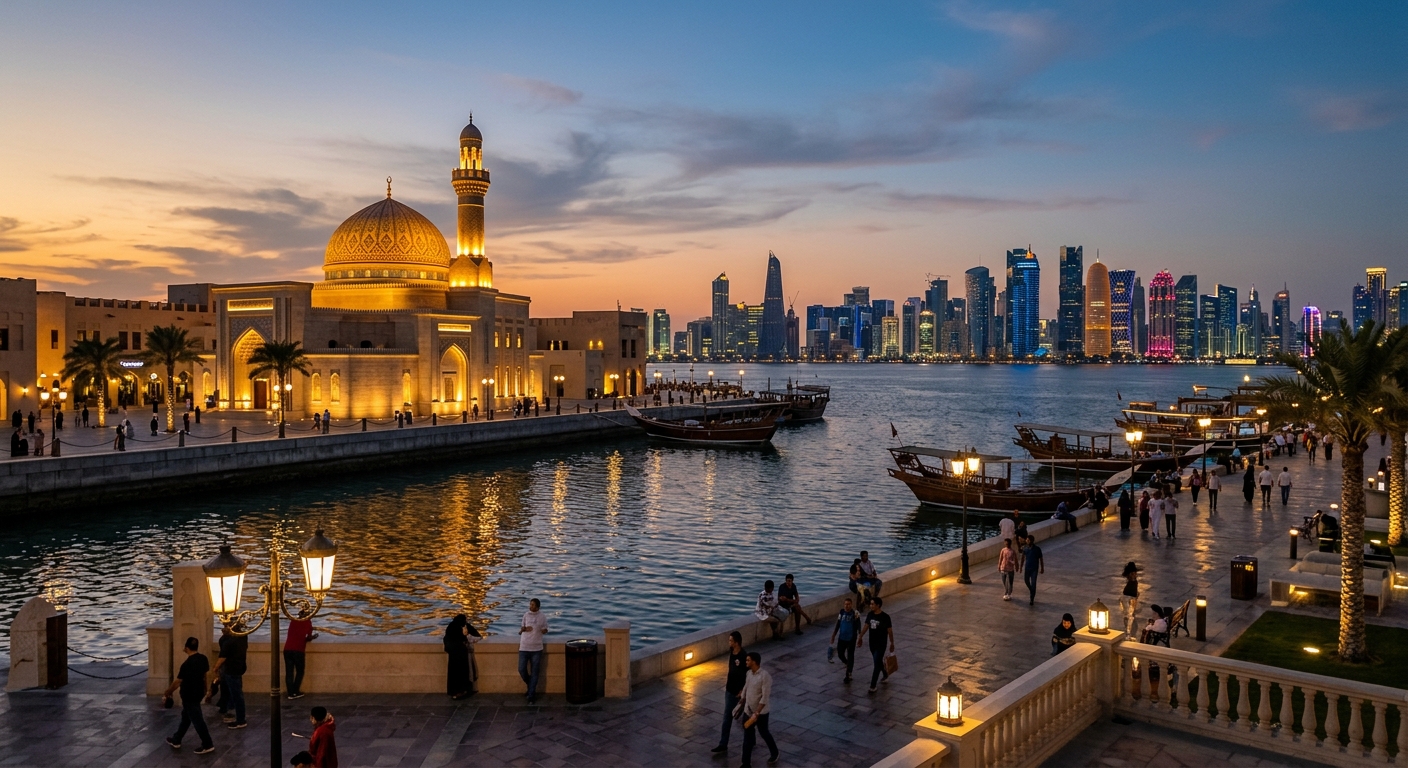
Katara is the most thoroughly documented beyond-the-resort destination in Doha for Gulf families — and the one with the clearest cultural anchors.
Location: On the waterfront between West Bay and The Pearl, accessible from both major hotel clusters.
What it contains:
- Katara Mosque and the Golden Masjid — two mosques on-site, making prayer logistics during a Katara visit straightforward
- Open-air Amphitheatre with events programming
- Katara Hills residential area
- Public beach access
- Arts, cultural, and heritage venues
Character distinction: Katara is not The Pearl (commercial and dining-focused) and not Souq Waqif (traditional market). It occupies a cultural-institution positioning — closer to a heritage district than a retail or resort experience.
Sources: Qatar Tourism Authority on Katara Village and Years of Culture Katara visitor guide 2025.
One gap to flag: Katara beach is publicly accessible and a modest-dress requirement is documented. Whether the beach operates with a segregated family section or a modesty-required mixed format is not confirmed in this article’s research base. Gulf families — particularly those traveling with women who wear hijab and families with teenage children — should confirm the beach configuration directly with Katara Cultural Village before building a beach day into your itinerary.
Halal Dining in Doha: The Distinction That Matters
Doha’s dining landscape requires one clarification that generic travel content consistently omits: not all restaurants in Doha are alcohol-free. Licensed venues — particularly hotel restaurants in mixed-use developments like The Pearl — serve alcohol. The majority of restaurants operate on a Muslim-default (no pork, no alcohol) basis. A smaller subset holds formal halal certification. A documented subset of hotel restaurants holds alcohol licenses.
Certified halal, reservation-required tier (documented by BookNBook halal restaurant listings):
- Rocca at Grand Hyatt (West Bay Lagoon) — Italian/Mediterranean, certified halal, reservable
- Nobu Doha at Four Seasons — Japanese, certified halal, reservable
Certified halal, accessible tier (documented by HalalTrip Doha restaurant listings):
- McDonald’s (halal-certified in Qatar)
- Afghan Brothers
Licensed venues at The Pearl (documented by Time Out Doha Pearl restaurant guide):
- Babel (Lebanese, St. Regis Marsa Arabia) — licensed
- Chicago Rare (Four Seasons) — licensed
If your family requires a fully alcohol-free dining environment, The Pearl’s hotel restaurant cluster requires specific venue-level checking rather than destination-level assumption. The Time Out Doha Pearl restaurant guide is the most useful English-language source for the licensed/non-licensed distinction at The Pearl specifically.
Souq Waqif, the Museum of Islamic Art, and Lusail
These are the other major beyond-the-resort destinations for Gulf families in Doha. They are documented across multiple sources at a passing level but not covered with the same depth as Katara in this article’s research base. The gap is a gap in the research, not a statement about their worth. Souq Waqif in particular is consistently referenced as a Doha anchor experience across the Doha-vs-Dubai comparison sources.
Doha vs. Dubai: The Honest Version
The “Doha is cheaper than Dubai” claim appears in nearly every Qatar travel editorial. It needs more precision than it typically receives.
What the corpus actually supports:
| Claim | Defensibility | Source |
|---|---|---|
| Doha 5-star hotels frequently cost less per night than equivalent Dubai 5-star properties | Defensible — specific to accommodation tier | Fly4Free 5 reasons to choose Doha |
| Doha is cheaper than Dubai overall | Not defensible without qualification | Tripbase Doha vs Dubai comparison: Doha at €60/day vs. Dubai at €45/day at the budget-traveler daily baseline |
| Doha beats Dubai on water clarity (7/10 vs. 5/10) | One editorial rating, not corroborated | Tripbase Doha vs Dubai comparison |
The defensible claim: Doha’s 5-star hotels frequently cost less per night than equivalent Dubai properties. But Dubai’s greater scale generates more competition across the mid-range and budget tiers — making a Dubai trip potentially cheaper overall for travelers not staying at the 5-star level. Compare by accommodation tier, not by destination.
Where Doha wins for Gulf families regardless of price:
- Relative calm and slower pace — consistent across Tripbase Doha vs Dubai comparison and FlyFono Dubai vs Doha honest differences
- Qatar’s stricter alcohol environment — a practical positive for observant Muslim families; licensed venues exist but are concentrated in hotel settings and not ambient in public spaces the way they are in Dubai
- Banana Island access — a boat-access island resort format with no Dubai equivalent (Fly4Free 5 reasons to choose Doha)
- Profile fit: FlyFono Dubai vs Doha honest differences explicitly names family travelers and those seeking cultural authenticity as the Doha-wins profile; entertainment-seekers and travelers who need scale and variety are the Dubai-wins profile
Frequently Asked Questions
Do GCC passport holders need a visa for Qatar?
No. GCC nationals — Saudi, UAE, Kuwaiti, Bahraini, Omani, and Qatari passport holders — enter Qatar visa-free with no fee or pre-registration. Confirm your tier against the Visit Qatar official visa check tool before travel.
What if I hold a non-GCC passport and live in Saudi Arabia or another GCC country?
Two options: Visa on Arrival at DOH (QAR 100, 30-day stay) if your profession appears on Qatar’s approved profession list and you carry health insurance and hotel confirmation; or a Hayya Platform eVisa applied for before travel, which bypasses the profession-list requirement. The Hayya Platform is the lower-risk pathway. The approved profession list is not publicly reproduced in any English-language source currently available — verify through the Visit Qatar official visa check tool or Qatar’s Ministry of Interior directly.
Is halal food easy to find in Doha?
Muslim-default dining (no pork, no alcohol) is the norm across most of Doha. Formally certified halal restaurants are documented at both the fine-dining tier (Rocca at Grand Hyatt, Nobu Doha) and the accessible tier (McDonald’s, Afghan Brothers). The distinction to know: hotel restaurants at The Pearl, including Babel and Chicago Rare, are licensed venues and serve alcohol. Check the licensed/non-licensed status of any Pearl restaurant before choosing it for a family meal.
How are prayer facilities at Hamad International Airport?
Extensive. 16 musallas distributed across all five concourses, separate male and female spaces, ablution facilities throughout, and an external 500-person mosque within walking distance of the Departures Hall. The adhan is broadcast terminal-wide. Full detail at the SalahPort guide to DOH prayer rooms and confirmed by the QAIA official prayer room page.
What is the best time of year to visit Qatar from the Gulf?
November through April for outdoor comfort (15–25°C), with UAE and Saudi school holidays in October, February, and April falling within this window. June through August for lower prices and fewer crowds — plan around indoor and resort activities given 40°C+ heat. Ramadan is a positive travel period for Gulf Muslim families, with documented cultural programming at Katara, Souq Waqif, and major hotels.
The Summary
Doha works well as a Gulf family short break on specific dimensions: prayer infrastructure at DOH is among the best in the region; the serviced-apartment tier directly addresses multi-generational family needs; Katara Cultural Village offers a cultural anchor with no direct Dubai equivalent; and Qatar’s ambient environment — lower alcohol presence, Islamic architectural identity, Ramadan-season programming — fits Gulf Muslim family priorities more naturally than Dubai’s more heterogeneous environment.
The gaps the corpus cannot fill: Qatar Airways fare data by Gulf departure city, the approved profession list for Visa on Arrival, and Hilton Salwa beach-segregation specifics. If you are traveling on a non-GCC passport, default to the Hayya Platform eVisa and do not rely on Visa on Arrival without confirming your profession against the approved list through the Qatar MOI directly.
Doha’s 5-star accommodation is price-competitive with Dubai’s equivalent tier. Doha is not cheaper than Dubai overall.

-
UAE4 days ago
Dubai Hotels for Gulf Families: Halal, Prayer & Zone Guide
-
 UAE4 days ago
Halal Hotels UAE: RAK, Fujairah & Dubai for Gulf Families 2026
-
 KSA3 days ago
Where to Stay in Saudi Arabia: Gulf Family Guide (2026)
-
 UAE3 days ago
UAE Travel Guide for Gulf Readers: Visa, Halal, Family Resorts & Eid Timing
-
 UAE4 days ago
UAE Resorts Beyond Dubai Beach: RAK, Fujairah, Hatta, and Abu Dhabi Islands
-
 UAE4 days ago
Dubai Resort Guide for Gulf Residents 2026: Halal Tiers, Resident Rates & Summer Pricing
-
 QA14 hours ago
Doha for Gulf Travelers: Halal Hotels, Districts & Qatar Airways Stopover